
The 154th Open Championship at Royal Birkdale is upon us. Here at Hindles, we are looking forward to seeing who will win this year, especially with The Open happening close to our Liverpool office. Perhaps Tommy Fleetwood will win as he returns to his hometown to compete in (what I think is) the best Major golf championship of the year. In the meantime, let’s take a look at some of the recent innovative developments in the golfing industry protected by patents and designs.

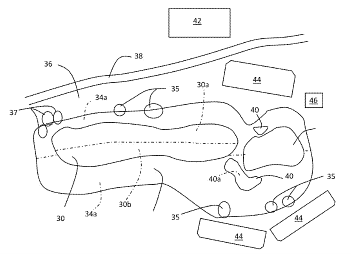
US11986699B1 is a granted US patent belonging to PGA Tour Inc. The patent was granted in 2024 and relates to a system for predicting a final resting position of a golf ball. The system has a ball tracking network which uses sensors, such as cameras and laser devices, positioned around a golf course to collect ball flight data of golf balls in flight.
The system also has a flight simulator which uses the ball flight data to predict coordinates of where the golf ball will first hit the ground and the physics of the impact of the landing.
Finally, the system also has a physics simulator engine which models how the ball will behave, depending on the shape and slope of where the golf ball first hits the ground. By predicting subsequent bouncing and rolling of the golf ball, the final resting position of the golf ball is predicted. The system updates the models by comparing predicted final resting positions with actual final resting positions to improve the accuracy of the model.
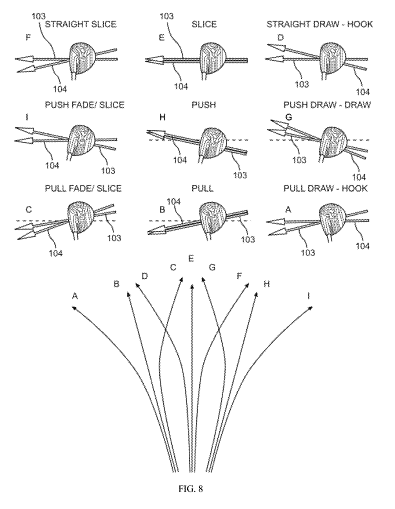
US12453916B2 is a granted US patent belonging to Shure Technology Inc. The patent was granted in 2025 and relates to smart glasses worn by golf players. The eyewear includes a camera which takes an image of the field of view of the player. The eyewear has a display which shows information to the wearer. The display shows a recommended stance to the player depending on what club they are using and a recommended swing path.
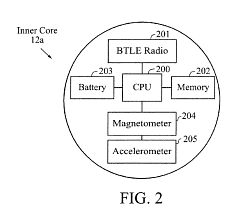
US12472417B1 is a granted US patent belonging to Topgolf Callaway Brands Corp. The patent was granted in 2025 and relates to a smart golf ball. The golf ball has a flexible circuit board inside with a number of electronic components thereon. The electronics include a magnetometer which is sensitive enough to measure 5,000 or more spins of the golf ball per minute. There is also an accelerometer, an inductor and some capacitors with a battery for power. The golf ball has a Bluetooth (RTM) transmitter with a range of 700 or more metres to cover the range of a golf course.
Design protection is also important in the world of golf. US design patent USD1094613S was granted in 2025 and belongs to Karsten Manufacturing Corporation (i.e. PING). The design appears to protect the head of an iron golf club. In particular, the clubface has indentations, and the back of the head has a geometric shape resulting from cut outs in the golf club head.
.png)
Thanks to developments in technology, it’s clear to see that world of golf has come a long way since the 15th century when it was first played. So, as Liverpool becomes golfing mad for the week, it’s nice to know that The Open is encouraging people to visit the home of another one of Hindles’ offices (and the birthplace of golf) … Scotland.

Article by: Phoebe Stones
Further advice
For further advice, please contact the team at Hindles.
The team’s strength is also rooted in its people. All attorneys bring strong academic credentials, with many holding PhDs and research backgrounds, allowing them to engage deeply with complex technologies.
IAM Patent 1000 - The World's Leading Patent Professionals, 2026 edition