Unconventional Trade Marks
View more

At the end of last month, fans of Peter Rabbit – among which the author of this article proudly counts herself – celebrated the 160th anniversary of Beatrix Potter’s birth. At Hindles, we took this opportunity to reflect on the artist’s special connection with Scotland and… Intellectual Property!
It was not far from Dunkeld, Perthshire, that Beatrix Potter wrote, in September 1893, the picture-letter which would set the décor for the now world-famous rabbit stories.
Originally from London, Beatrix Potter and her family would often holiday in Perthshire where she would delight in observing nature (especially mushrooms!) and improving her drawing skills.[1]
Although she decided against dressing Peter Rabbit in a kilt – which everyone would agree is highly regrettable – she did allude to Scotland in her stories, from Benjamin Bunny’s Big Tammy beret to McGregor’s very name.
In addition to being a skilful artist and a passionate conservationist, Beatrix Potter also showed an acute sense of marketing, and an awareness of the role Intellectual Property could play in protecting her world.
She learned this lesson the hard way. Her publishers having failed to protect the copyright in her work in the US, she witnessed the appearance of a wave of pirated editions there. She also came to realise that her art made for very good merchandise, from soft toys to board games, nursery wallpaper to crockery sets, and much more! Before any others tried to ride on Peter’s coattails, Beatrix Potter worked tirelessly to put in place licensing agreements with industrialists in the UK and abroad. To ensure she would have control over Peter’s representations, on 28 December 1903, Beatrix Potter, registered a doll design for Peter Rabbit at the then Patent Office in Chancery Lane, London.[2]
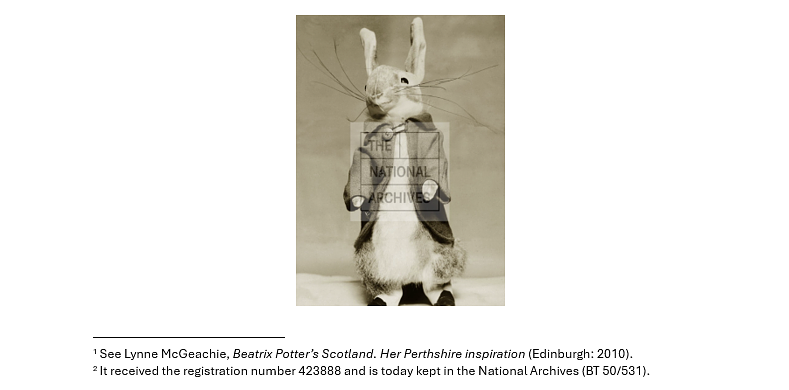
In all these endeavours, Beatrix Potter showed a brilliant understanding of how she could be both a creative and “industrial author” at a time where there were fewer options for the protection of commercial products derived from creative works.[3] Although she called these activities her “sideshows”, they proved particularly successful, securing her financial independence and establishing Peter Rabbit as the oldest licensed character.
Since 2014, Beatrix Potter’s published work has entered public domain. However, this does not mean that her world is now free-for-all.
Following her death, her publisher Frederic Warne & Co. (now a division of Penguin) held the exclusive rights to her characters, names and illustrations and, knowing that copyright protection does not last forever, they adopted a smart IP strategy in good time, by turning to trade mark protection.
A brief look on the UK Trade Mark Register and one can see that Frederic Warne & Co. launched a comprehensive programme of registrations between the 1980s and 2010s, which are still in force to this day. Not only did they consider it important to protect the names (PETER RABBIT, JEMINA PUDDLE-DUCK, BENJAMIN BUNNY), but also the black-and-white drawings of Beatrix Potter’s famous characters. They also succeeded in registering specific scenes from the books and even Beatrix Potter’s signature. The same strategy was adopted worldwide by Frederic Warne & Co., contributing to the establishment of an impressive trade mark portfolio for such a small rabbit.
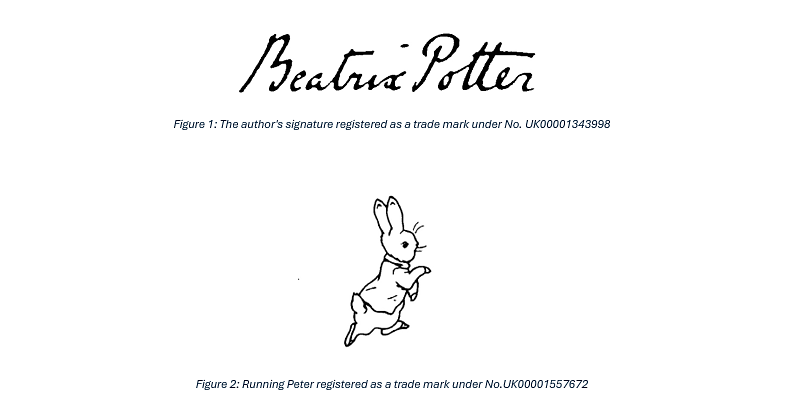
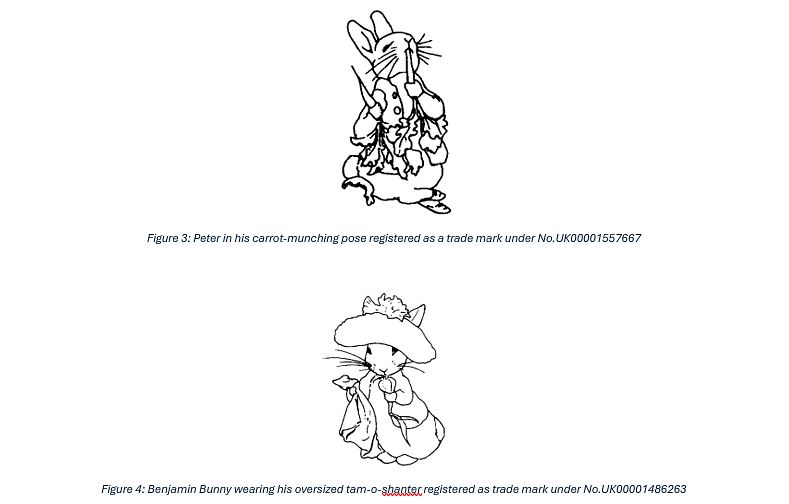
This wave of successful trade mark registrations is certainly proof of the proactive attitude of Warne & Co when it comes to IP. More importantly, it is a testimony of the incredible talent of Beatrix Potter, whose skills conferred onto humble children book’s characters sufficient distinctiveness and singularity to make them powerful signs of trade origin, even in today’s brand-saturated marketplace.
If there is a lesson to take from this, it is that creativity and business awareness can work marvels together, with IP acting as an effective bridge between the two and ensuring control and reward remain the author’s privilege.
And with this, we say: “Long live Peter and Co.”!
Author: Alix de La Motte-Broöns
For further advice, please contact the trade marks team at Hindles.
[1] See Lynne McGeachie, Beatrix Potter’s Scotland. Her Perthshire inspiration (Edinburgh: 2010).
[2] It received the registration number 423888 and is today kept in the National Archives (BT 50/531).
[3] Jose Bellido and Kathy Bowrey, “Books, Toy Books and the Artfulness of Consumption”, in Adventures in Childhood Intellectual Property, Imagination and the Business of Play, Chapter 2, pp. 38 – 69 (Cambridge: 2022)
An occasional newsletter about patents, trade marks, designs and other intellectual property matters.