What Would Taylor Swift Do: Trademarks Version
View more

Toy Story 5 is released this week, and we get to see Woody, Buzz, Jessie and the rest of the gang deal with their newest enemy – Lilypad, the electronic tablet.
Intellectual property runs throughout the Disney-Pixar films. A brief trip to my local supermarket shows how the Toy Story intellectual property has been used to market and advertise the upcoming release of film number 5 to everyone doing their weekly shop!
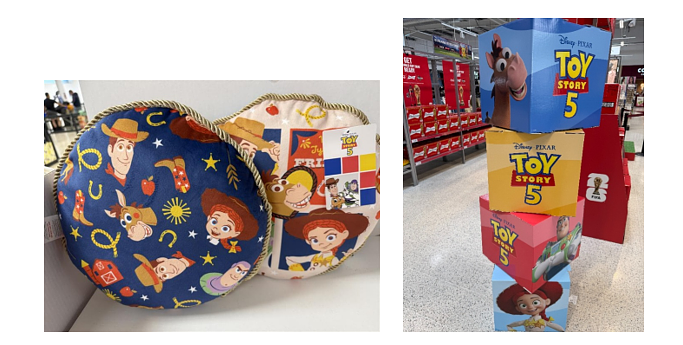
In this article, we thought we’d explore some of the intellectual property rights relating to the Toy Story film series.
The first Toy Story film was made using computer generated imagery and animation with a level of detail that had simply not been done before. This was made by possible by the creation of the RenderMan software by engineers at Pixar, which is still used in film making to this day. Starting life as a software called ‘REYES’ (Renders Everything You Ever Saw), RenderMan got its final name after the idea that the technology could one day fit in your pocket, like a Sony Walkman.
Pixar applied for many patents for the methods used in the RenderMan software, such as US5194969. This patent was directed at a method for borderless mapping of textured images but is now expired.
Prior to this patent, computer graphics images were made by drawing shapes (e.g. using a computer mouse) which were then filled with a single colour or by repeating tiles of symmetrical patterns (e.g. tiles of bricks). Only symmetrical patterned tiles had been used up to then, because it was possible to blend the edges of adjacent symmetrically patterned tiles so that the border between adjacent tiles was not visible.
The technology in this patent enabled the shapes drawn for computer graphics images to be filled with realistic, non-symmetrical patterns such as wood or stone. The claimed method involved taking a sample image tile of a textured surface (e.g. an image of a real surface) and dividing the sample image tile up into multiple smaller portions.
These smaller portions have outer edges that are the original outer edge of the sample image tile. The smaller portions also have inner edges that are inside the sample image tile. The inner edges of one portion border other inner edges of adjacent portions. The portions are then rearranged so that the outer edges become inner edges and the inner edges become outer edges.
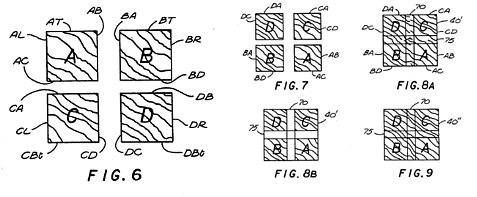
By this point you have a rearranged image tile where the outer edge of the original sample image tile is distributed across the inner edges of the smaller portions. The inner edges of the mixed-up image tile are then blended to remove the border between the inner edges. The result is an image tile that has no harsh borders and can therefore be used repeatedly to fill a shape in a computer graphics image.
This set Toy Story apart from previous computer generated imagery films as the animators were able to make textures, like the denim on Woody’s jeans, look far more realistic than had been possible before.
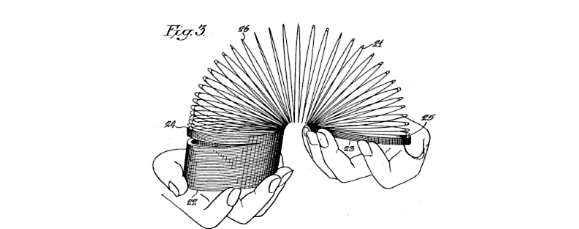
Moving on to the patent for the Slinky, a toy from the 1940’s which found a home in Andy’s bedroom in the form of Slinky Dog. The original patent for the Slinky toy was US2415012. This patent protected a toy with a helical spring which oscillates at a frequency of between 10 to 100 cycles per minute. The spring was further defined by the feature specifying that when the coils of the spring are at rest, there is no lateral force between the coils and adjacent coils contact one another. This is a relatively simple patent, but the toy it protected has provided hours of entertainment for kids across the world!
Disney-Pixar also enjoys an extensive global trade mark portfolio, including the word mark TOY STORY, the iconic Toy Story logo, and the name of its much-loved superhero action figure, BUZZ LIGHTYEAR, to name but a few.
Their trade mark registrations cover not only entertainment as a service, but also a wide range of goods, including classic merchandise products such as clothing and toys. This is particularly significant given Disney’s undisputed status as the top global licensor. As of 2025, their global retail sales of licensed consumer products were almost double those of their nearest competitor, at around $62 billion. License Global puts their success down to four key factors: identity expression, multi-generational bonding, everyday brand moments (such as food and beverage licensing), and fandom culture and community.
Add all this to the extensive copyright subsisting in their characters, films, and music, and it’s clear to see that Disney-Pixar are not playing around when it comes to intellectual property…To infinity and beyond!
Article by: Phoebe Stones and Fiona Jones
For further advice, please contact the team at Hindles.
The team’s strength is also rooted in its people. All attorneys bring strong academic credentials, with many holding PhDs and research backgrounds, allowing them to engage deeply with complex technologies.
IAM Patent 1000 - The World's Leading Patent Professionals, 2026 edition
An occasional newsletter about patents, trade marks, designs and other intellectual property matters.